About ANZACS-QI

About Us

Aotearoa New Zealand All Cardiology Services Quality Improvement

Who we are

Aotearoa New Zealand All Cardiology Services Quality Improvement (ANZACS-QI) is a national programme that collects and reports cardiology data to improve heart care across Aotearoa New Zealand. It collects clinical data from hospitals across the country, including information on acute coronary syndromes, heart failure and cardiac interventions. The data is analysed and reported back to hospitals to support better patient care and more equitable outcomes.

The ANZACS-QI Governance Group includes clinical representatives from across Aotearoa NZ, together with equity, consumer and Te Whatu Ora/ Health New Zealand representation.

ANZACS-QI is funded by Health New Zealand and delivered in partnership with the University of Auckland and Enigma Solutions.

ANZACS-QI is guided by the principles of Te Tiriti o Waitangi and works in partnership with the University of Auckland VAREANZ (Vascular Risk Equity for Aotearoa New Zealand) Māori co-led governance group which is focused on data sovereignty and health equity in cardiology services.

ANZACS-QI’s founder, Prof. Andrew Kerr, continues to actively support and guide the programme.

History of ANZACS-QI

Established in mid-2007, an Acute Coronary Syndrome (ACS) registry was introduced at Middlemore Hospital in Auckland, New Zealand, led by Prof. Andrew Kerr. It was initially named Acute Predict and was used in Counties Manukau DHB and then in Waikato and Waitemata.

2007

A Cath PCI (Catheterisation Percutaneous Coronary Intervention) registry was added in 2010.

2010

A year later, the NZ National Cardiac Network suggested combining the two sub-registries to become a national ACS-Cath PCI registry called the All NZ Acute Coronary Syndrome Quality Improvement  (ANZACS-QI) programme. This was funded by the Ministry of Health and managed by the National Institute for Health Innovation (NIHI) and Enigma Solutions Limited.

2011

Overtime, the registry’s role expanded to include data collection on patients receiving cardiac implantable electronic devices (pacemakers and implantable cardiac defibrillators) and those with heart failure.

OVER TIME..

By November 2013, the registry had grown to include all 20 publicly funded District Health Boards and their 41 hospitals providing care to ACS patients.

2013

ANZACS-QI was delivered to the Ministry of Health in response to an RFP (request for proposal). At this point, the programme was renamed as ‘Aotearoa New Zealand All Cardiology Services Quality Improvement’ as part of the National rollout.

2023

ANZACS-QI, together with its experienced biostatistics and project management team, has moved into the Human Health Research Services Platform (HHRSP), hosted by the Liggins Institute at the University of Auckland. This transition strengthens the programme’s foundation and ensures ongoing support for national cardiac care improvement.

2025

Today, the registry encompasses all public hospitals that manage cardiology services and captures data from all cardiology procedures performed in private hospitals in New Zealand. A monumental effort from all our contributors across a total of 47 hospitals (both public and private) enrolled in the registry who have captured over 244,845 Episodes of Care (EoC) to date.  

TODAY

History of ANZACS-QI

Established in mid-2007, an Acute Coronary Syndrome (ACS) registry was introduced at Middlemore Hospital in Auckland, New Zealand, led by Prof. Andrew Kerr. It was initially named Acute Predict and was used in Counties Manukau DHB and then in Waikato and Waitemata.

2007

A Cath PCI (Catheterisation Percutaneous Coronary Intervention) registry was added in 2010.

2010

A year later, the NZ National Cardiac Network suggested combining the two sub-registries to become a national ACS-Cath PCI registry called the All NZ Acute Coronary Syndrome Quality Improvement  (ANZACS-QI) programme. This was funded by the Ministry of Health and managed by the National Institute for Health Innovation (NIHI) and Enigma Solutions Limited.

2011

Overtime, the registry’s role expanded to include data collection on patients receiving cardiac implantable electronic devices (pacemakers and implantable cardiac defibrillators) and those with heart failure.

OVER TIME..

By November 2013, the registry had grown to include all 20 publicly funded District Health Boards and their 41 hospitals providing care to ACS patients.

2013

ANZACS-QI was delivered to the Ministry of Health in response to an RFP (request for proposal). At this point, the programme was renamed as ‘Aotearoa New Zealand All Cardiology Services Quality Improvement’ as part of the National rollout.

2023

ANZACS-QI, together with its experienced biostatistics and project management team, has moved into the Human Health Research Services Platform (HHRSP), hosted by the Liggins Institute at the University of Auckland. This transition strengthens the programme’s foundation and ensures ongoing support for national cardiac care improvement.

2025

Today, the registry encompasses all public hospitals that manage cardiology services and captures data from all cardiology procedures performed in private hospitals in New Zealand. A monumental effort from all our contributors across a total of 47 hospitals (both public and private) enrolled in the registry who have captured over 244,845 Episodes of Care (EoC) to date.  

TODAY
Tap on the left / right buttons

Governance of ANZACS-QI

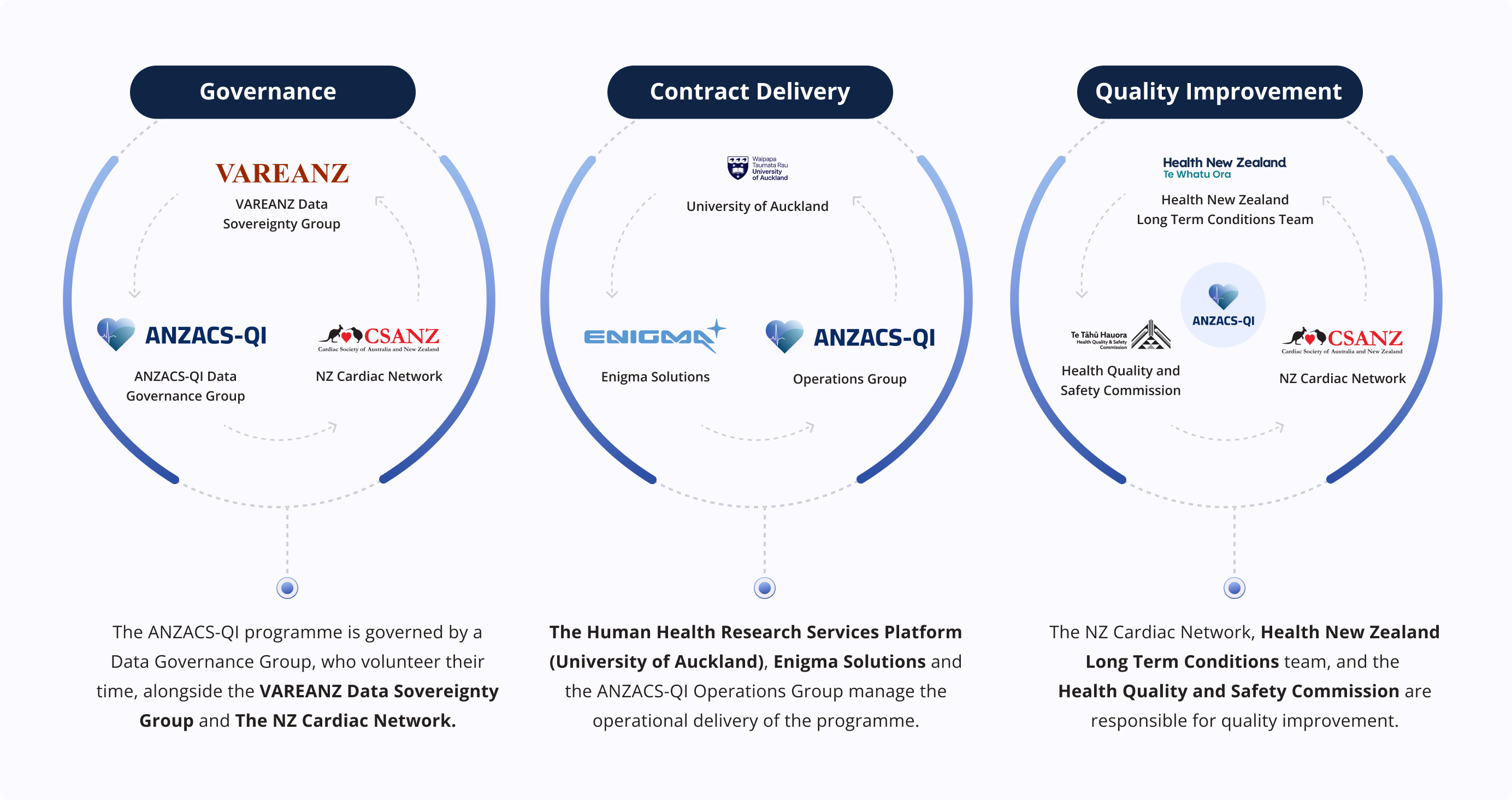
The ANZACS-QI programme is guided by a strong governance framework to ensure accountability, equity, and clinical leadership. Oversight comes from the ANZACS-QI Data Governance Group, working in partnership with the VAREANZ Data Sovereignty Group and the New Zealand Cardiac Network (CSANZ).
The diagram below shows how governance, contract delivery, and quality improvement responsibilities are shared across organisations:

Governance of ANZACS-QI

The ANZACS-QI programme is guided by a strong governance framework to ensure accountability, equity, and clinical leadership. Oversight comes from the ANZACS-QI Data Governance Group, working in partnership with the VAREANZ Data Sovereignty Group and the New Zealand Cardiac Network (CSANZ).
The diagram below shows how governance, contract delivery, and quality improvement responsibilities are shared across organisations:

Members of the Governance Group

The ANZACS-QI Governance Group is jointly chaired by:

CSANZ Co-chair (nominated by the NZ branch of the Cardiac Society of Australia and New Zealand)
Equity Co-chair (nominated by VAREANZ, a Māori co-led governance group based at the University of Auckland)
Other members include:

Clinical leaders from the National Cardiac Network
The Chair of the NZ branch of CSANZ
Representatives from Te Whatu Ora | Health New Zealand
Clinicians from across New Zealand
Māori, nursing, and consumer representatives

This diverse membership ensures ANZACS-QI decisions are clinically robust, equity-focused, and aligned with both national health priorities and community needs.


Current members include:
Alexander Sasse
Cara Wasywich
Charmaine Flynn
Chris Wiltshire
Daniel Chan (CSANZ co-chair)
Gerry Devlin
Harvey White
Jo Muschamp 
John Edmond
Kevin Murray
Lia Sinclair
Martin Stiles
Matire Harwood
Matthew Webber
Mayanna Lund
Michael Williams
Paul Bridgman
Sarah Fairley 
Shawn Foo
Sue Crengle
Wil Harrison (Equity co-chair)
Alexander Sasse
Andrew Kerr (CSANZ co-chair)
Cara Wasywich
Chris Wiltshire
Daniel Chan
Gerry Devlin
Harvey White
Jo Muschamp 
Kevin Murray
Kim Marshall
Lia Sinclair
Martin Stiles
Matire Harwood
Mayanna Lund
Michael Williams
Paul Bridgeman
Sarah Fairley 
Shawn Foo
Sue Crengle
Wil Harrison (Equity co-chair)

Members of the Governance Group

The ANZACS-QI Governance Group is jointly chaired by:

CSANZ Co-chair (nominated by the NZ branch of the Cardiac Society of Australia and New Zealand)
Equity Co-chair (nominated by VAREANZ, a Māori co-led governance group based at the University of Auckland)
Other members include:

Clinical leaders from the National Cardiac Network
The Chair of the NZ branch of CSANZ
Representatives from Te Whatu Ora | Health New Zealand
Clinicians from across New Zealand
Māori, nursing, and consumer representatives

This diverse membership ensures ANZACS-QI decisions are clinically robust, equity-focused, and aligned with both national health priorities and community needs.


Read more & view all members
Alexander Sasse
Cara Wasywich
Charmaine Flynn
Chris Wiltshire
Daniel Chan (CSANZ co-chair)
Gerry Devlin
Harvey White
Jo Muschamp
John Edmond
Kevin Murray
Lia Sinclair
Martin Stiles
Matire Harwood
Matthew Webber
Mayanna Lund
Michael Williams
Paul Bridgman
Sarah Fairley 
Shawn Foo
Sue Crengle
Wil Harrison (Equity co-chair)

For further details, see Terms of Reference - Aotearoa New Zealand All Cardiology Services Quality Improvement (ANZACS-QI) Data Governance Group. 

Read less

"Our experience demonstrates that ANZACS-QI is a useful and expedient tool in providing information for retrospective analysis as well as ongoing service planning and development within cardiology services.

Increasingly we are using ANZACS-QI as an important resource for staff training and education."

Goodson, J., & Tisch, J. (2015)
What is it for? Heart, Lung and Circulation, 24(2), 27.

Our experience demonstrates that ANZACS-QI is a useful and expedient tool in providing information for retrospective analysis as well as ongoing service planning and development within cardiology services.

Increasingly we are using ANZACS-QI as an important resource for staff training and education.

Goodson, J., & Tisch, J. (2015)
What is it for? Heart, Lung and Circulation, 24(2), 27.

Funding

ANZACS-QI’s programme management, IT infrastructure, and audits are funded by Health New Zealand | Te Whatu Ora. Each participating hospital provides local support for data entry. Research projects that use registry data are funded separately through external funding agencies.

Funding

ANZACS-QI’s programme management, IT infrastructure, and audits are funded by Health New Zealand | Te Whatu Ora. Each participating hospital provides local support for data entry. Research projects that use registry data are funded separately through external funding agencies.